
Composite Fabrication & Molding
Our goal is to provide rapid, cost-effective, and high-quality composite fabrication and molding solutions to meet and exceed your project requirements, no matter if the project requires autoclave, oven, or press curing.
Composite Curing: Autoclave, Press, & Oven Cured
ACP Composites is proud to offer the most complete and comprehensive assortment of composite fabrication, molding, and curing equipment under one roof in our California-based facility. Our composite fabrication and molding facility operates autoclaves, ovens, and presses capable of creating some of the most advanced and premium-quality composite products in the industry. Work with our experienced and dedicated team to find the optimal curing process for your composite fabrication and molding requirements, no matter the scale of production.
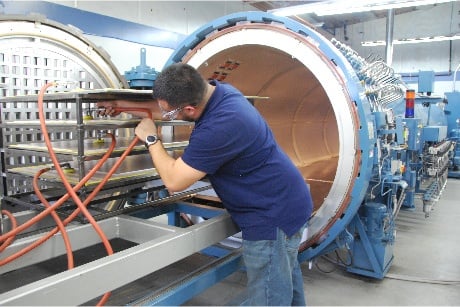
For composite fabrication and molding jobs that require out-of-autoclave processes, our industrial ovens are equipped with programmable temperature controllers, allowing for specific cure profiles and precise monitoring of metrics. The maximum work envelope is 6 ft. x 8 ft. x 16 ft. with a maximum temperature of 650℉. For a full list of our autoclave curing equipment, please view our Facilities Equipment List or reach out for more information.
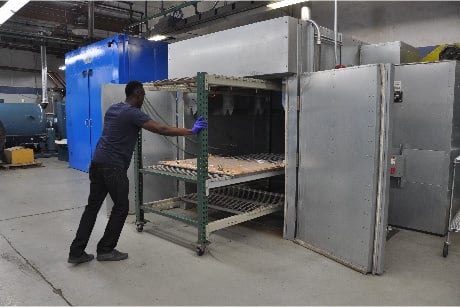
For out-of-autoclave processes, our industrial ovens are equipped with programmable temperature controllers, allowing for specific cure profiles and precise monitoring of metrics. The maximum work envelope is 6 ft. x 8 ft. x 16 ft. with a maximum temperature of 650°F. For a full list of equipment, view our Facilities Equipment List.
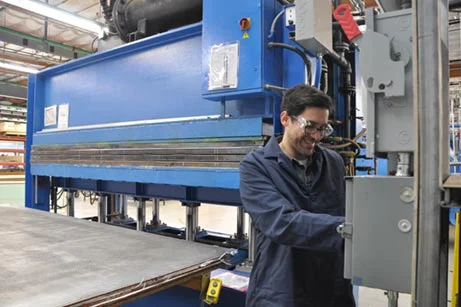
Composite fabrication and molding of solid flat panels, sandwich panels, and laminates uses two (2) 5 ft. x 10 ft., multi-opening laminating presses that have a maximum operating temperature of 350℉. A variety of mid-sized presses for compression molding applications of thermoplastic parts is also available. For a full list of our press curing equipment, please view our Facilities Equipment List or reach out for more information.
Understanding Autoclave, Oven, and Press Curing in Composite Fabrication
Different composite fabrication and molding applications, industry standards, and part designs demand different curing methods, and choosing the right process is essential for achieving the desired strength, weight, dimensional tolerances, and surface finish. ACP Composites offers autoclave, oven, and press curing options to support everything from aerospace-grade laminates to high-volume structural composite panels. By offering all three curing technologies under one roof, ACP Composites ensures each project is matched with the optimal process for performance, manufacturability, and cost efficiency.
Autoclave Curing
Ideal for high-performance, aerospace-level components where precision and maximum consolidation are required. The carefully measured combination of heat, vacuum, and high pressure results in excellent fiber-to-resin ratios, minimal void content, and tight dimensional tolerances. This method is typically selected for complex geometries, thin-wall structures, and critical flight- or mission-ready composite parts.
Oven Curing
Provides a flexible, cost-effective option for out-of-autoclave prepregs, wet layups, and resin infusion systems. Without the pressure of an autoclave, oven curing is best suited for medium-performance components, larger structures, and applications where strength requirements are balanced with budget or tooling limitations. Programmable temperature control allows precise cure profiles while accommodating oversized or uniquely shaped parts.
Press Curing
Delivers uniform heat and pressure across flat or lightly contoured parts such as composite panels, sandwich structures, and thermoplastic forms. This method excels in producing consistent thickness, smooth surfaces, and efficient cycle times for mid- to high-volume production runs.
Composite Molding & Fabrication
By utilizing the benefits of our on-site AS9100 and ISO 9001 certified composite molding and fabrication capabilities, we guarantee that all unique design specifications will be adhered to from start to finish. Our team combines proprietary manufacturing solutions with a diverse array of standardized, yet advanced, composite fabrication and molding methods. Including but not limited to:
- Vacuum Bag Molding
- Compression Molding
- Resin Infusion Molding
- Bladder Molding
- Roll Wrapping
- Hand Layup
Laser Projection Systems
Our qualified technicians use the Virtek Laser Projection System to aid in assembling and processing materials with a high degree of accuracy. The green laser light is a rapid inspection system that measures the accuracy of two-dimensional parts within 0.05mm (0.002 in) and three-dimensional parts within 0.25mm (0.010in). The Virtek Laser helps control accurate ply placement and further increase manufacturing throughput while maintaining quality and costs.
Tooling & Mold Production
Successful composite fabrication and molding projects depend on quality tools and tight–tolerance molds. When you choose ACP Composites for these projects, you’re trusting our experience to deliver tooling solutions you can depend on. With our fleet of advanced 3-axis and 5-axis CNC machining centers, layup processes, qualified tooling specialists, and material selection knowledge, ACP Composites is a head above the competition. Solutions for tooling and mold production as related to composite manufacturing include:
- Metal, Composite, & Rapid Prototyping Molds
- Assembly/Machining Fixtures & Jigs
- CNC Trim Fixtures
Material Availability
We offer on-site freezer storage and warehouse space to accommodate the growing demand for various composites and finished parts that require special attention. At ACP Composites, our goal is to make the entire fabrication and molding process as simple as possible. To reinforce this position, we offer a diverse maintain a diverse range of composite manufacturing materials in-house and can source any additional materials available on the market as needed. Our offers include:
- Fabric (Carbon Fiber, Fiberglass, & Kevlar)
- Prepreg (Carbon Fiber, Fiberglass)
- Honeycomb (Aluminum, Plastic, Nomex)
- Foam (Polyurethane, PVC, ABS, & others)
- Film adhesive and ancillary production materials
- Composite Tubes, Rods, Laminates, and Panels